Ways around the strait
What genuinely bypasses the Strait of Hormuz, what only appears to, and why the honest answer starts with a limitation rather than a list.
Start with what does not work
The Cape of Good Hope is the answer to a different question. Routing around southern Africa avoids the Suez Canal and Bab el-Mandeb, and it is what shipping does when the Red Sea becomes unusable. It does nothing for Hormuz, because a ship still has to get out of the Persian Gulf before any of that applies.
This is the distinction that gets lost when the two chokepoints are discussed together. Bab el-Mandeb has an expensive alternative. Hormuz has none at sea.
The pipelines that genuinely bypass it
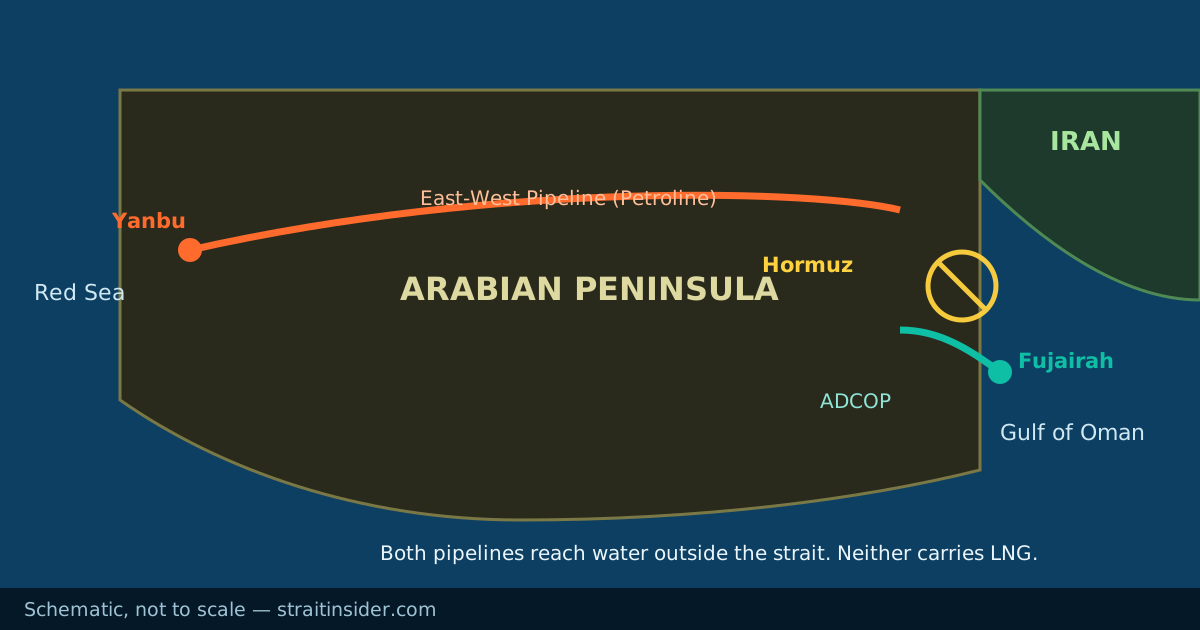
Two overland pipelines move Gulf crude to terminals outside the strait, and they are the real bypass capacity.
- East-West Pipeline (Petroline)
- Saudi Arabia, from the Eastern Province across to Yanbu on the Red Sea, reaching export terminals outside the Gulf entirely.
- Abu Dhabi Crude Oil Pipeline
- From the Habshan fields to Fujairah on the UAE’s Gulf of Oman coast, which sits outside the strait.
Why the capacity gap decides everything
Bypass capacity is measured in a few million barrels a day. Normal flow through the strait is several times that. Analyst scenarios during the current disruption have assumed roughly 2.6 million barrels a day of Saudi and UAE pipeline bypass, against strait volumes far larger.
And since September 2026 there is a second catch. The Saudi pipeline delivers to Red Sea terminals, and a tanker loading there still has to pass Bab el-Mandeb — which is itself disrupted. Both chokepoints constrained at once removes much of what made this route a bypass.
So the pipelines change the shape of a disruption without preventing one. They keep some crude moving and some revenue flowing; they cannot substitute for the waterway. What that means for prices follows directly from the size of that gap.
Ports outside the strait
Fujairah and Khor Fakkan sit on the UAE’s Gulf of Oman coast, beyond the strait, and have absorbed cargo that would otherwise have moved through it. Omani ports serve the same function, and land bridges across the Arabian Peninsula move containers where sea routing has become unattractive.
None of this helps a cargo that is already inside the Gulf and has no pipeline connection. That is the constraint no amount of port investment removes.
And the cargo with no bypass at all
Liquefied natural gas is the sharpest case. Qatar’s LNG exports have no pipeline route out, which makes them wholly dependent on the strait in a way crude is not.
Common questions
- Can ships go around the Strait of Hormuz?
- No. It is the only sea passage in or out of the Persian Gulf. Routing around Africa avoids Suez and Bab el-Mandeb but does not avoid Hormuz.
- What pipelines bypass the Strait of Hormuz?
- Saudi Arabia’s East-West Pipeline to Yanbu on the Red Sea, and the Abu Dhabi Crude Oil Pipeline to Fujairah on the Gulf of Oman. Together they carry far less than normally transits the strait.